
Comparison of Cost of Proton Beam Therapy with Other Countries
The average cost of proton beam therapy in India is 40,00,000 INR (~$45,000) and varies depending on factors like the number of brackets/fractions, among other factors. Here's a country-wise cost comparison:
| Country |
Cost (USD) |
| India |
$45,000-$60,000 |
| US |
$155,000-$205,000 |
| UK |
$80,000-$120,000 |
| Canada |
$80,000-$120,000+ |
| Turkey |
$70,000-$100,000 |
| Germany |
$165,000-$230,000 |
The affordability that’s promised in India for Proton Beam Therapy is found to be true when you take a look at the cost comparison.
You can expect the cost of this surgery to be dependent on the number of brackets (fractions/number of treatment sessions.)
For example, in case of brain tumor - let’s assume the size of the tumor requires 30 fractions/brackets of the proton beam. So, the cost of 30-fraction proton beam therapy could range from 20,00,000 INR to 30,00,000 INR ($24,000 to $50,000 or more) in India.
In the US, the therapy costs between $150,000 to $250,000 (irrespective of the number of fractions), depending on the center and its treatment plan.
European countries also have high costs, offering treatment from EUR 140,000 to EUR 200,000. As is evident, the cost of this treatment in India is more affordable in their comparison.
On the other hand, in India, Proton Beam Therapy can save you a lot of money without compromising the quality. The costs, coupled with the state-of-art healthcare system and increasing number of accredited hospitals concentrating on cancer treatment make India accessible and a preferred destination for overseas patients.
Proton Beam Therapy & Its Types
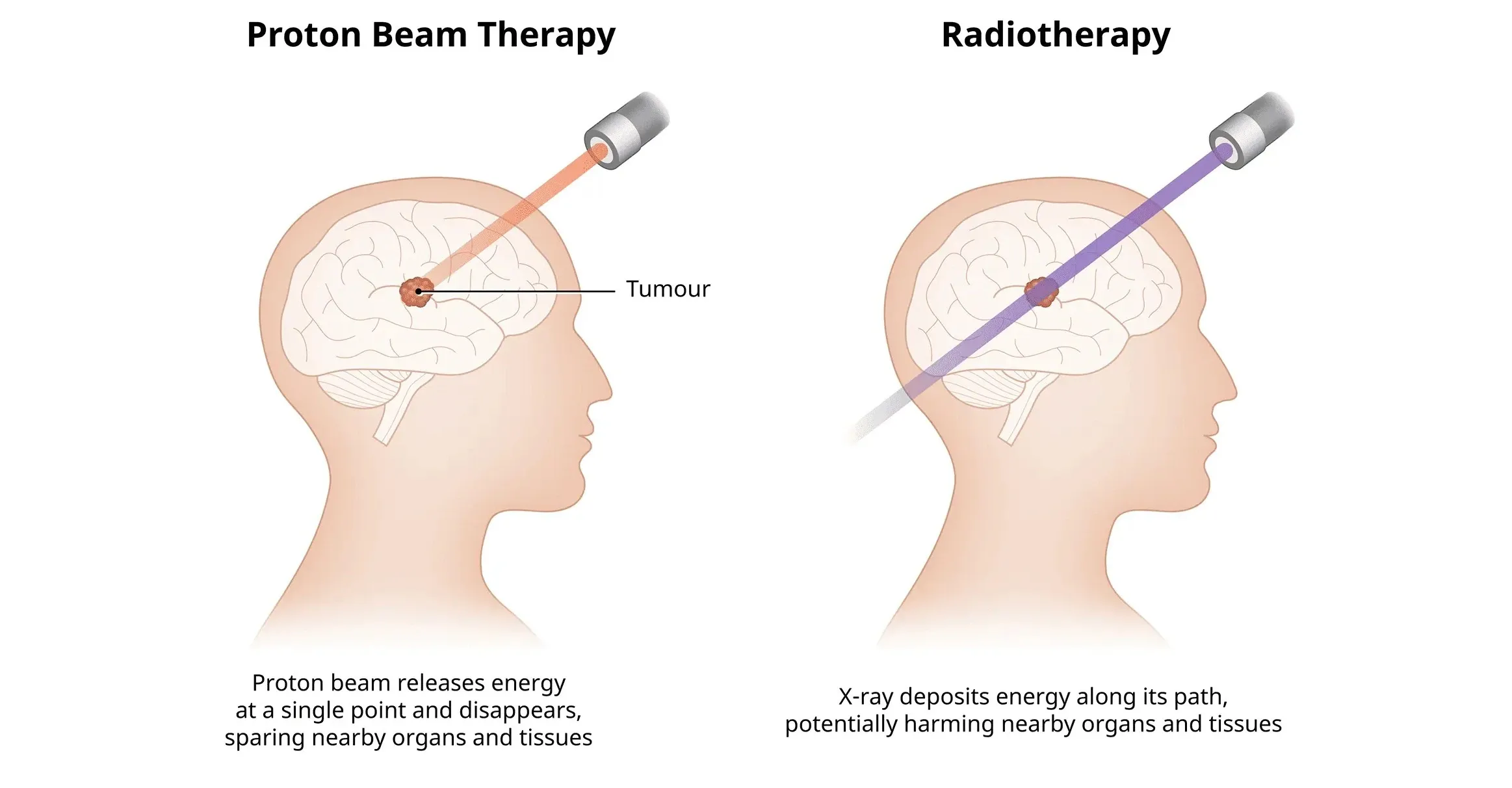
Proton Beam Therapy or PBT is a type of radiation therapy that is effective in cancer cases, especially those that are too close to an essential organ. For example, if you have a tumor near your heart and you use traditional radiation therapy, there’s a high risk of damage to the heart.
Precisely targeting such tumors is best done with the help of procedures such as proton beam therapy, as it uses positively charged particles/beams to target cancer cells and destroy them.

This is also helpful in cases when chemotherapy and other traditional cancer treatments do not provide the desired results. It is also effective in the case of non-cancerous tumors. Especially in cases when there’s a need of re-radiation therapy and the doctor recommends this, instead
The therapy usually has two main types:
-
Pencil Beam Scanning (PBS) -
A technique that’s more precise than Intensity-Modulated Radiation Therapy or IMRT is Pencil Beam Scanning Proton Therapy. Also known as Intensity Modulated Proton Therapy, this technique uses less radiation that does not harm the surrounding healthy cells.
However, this technique is unhelpful in cases of tumors that are too close to delicate structures such as nerves or vessels.
-
Passive Scattering Proton Beam Therapy (PSPT)
This second type of PBT uses a single ray of protons to target the cancer cells. As the name suggests, this narrow beam of protons is scattered using scattering devices that create a uniform dose.
Scattering devices such as scatter foils help spread the narrow beam, delivering the required dose to the target area. Your surgeon can help you understand which one of the two types will be chosen in your case after conducting their analysis.

Uses of PBT
-
Primarily used for treating cancer and some non-cancerous tumors.
-
Minimizes the risk of damage to surrounding healthy tissues
-
It brings fewer side effects in comparison to other radiation therapy, especially in patients with recurrent tumors.
-
Great as an option for re-radiation when tumor has returned after previous radiation therapy.