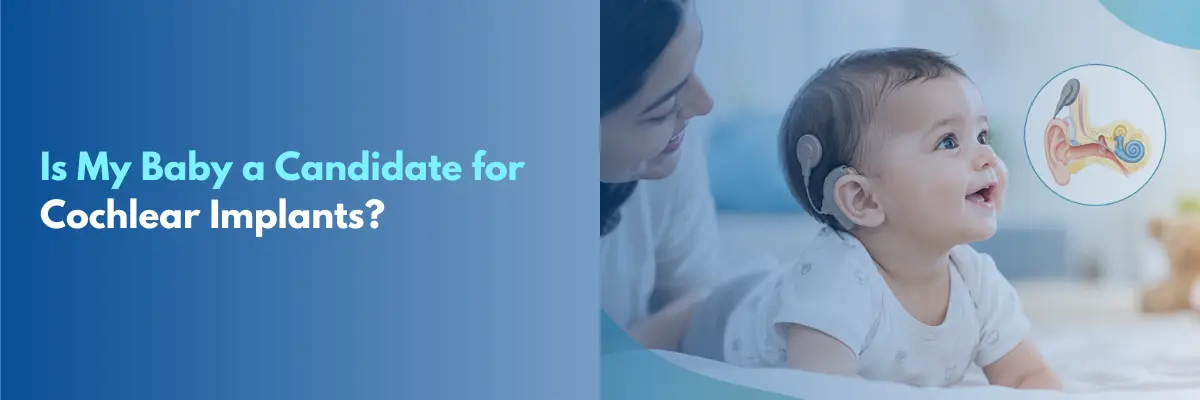
Cochlear implant eligibility for babies is generally determined by multiple factors, including the risk and type of congenital deafness, auditory development, hearing aids, inner-ear anatomy, and overall health.
Infants or babies with severe-to-profound bilateral sensorineural hearing loss can benefit from cochlear implants rather than hearing aids, which have limited benefits. This type of implant gives children access to sound when they cannot hear auditory information with hearing aids.
This is because hearing is a crucial part of children’s early development in terms of communication, early speech, and language development. Recognizing potential candidates can assist babies’ or children’s families in guiding them through the necessary options without delay.
However, it is to be noted that cochlear implants for babies are not suggested based on only one hearing test. A highly professional team is to analyze the baby’s hearing, development, anatomy, medical history, and family history, if required, before coming down to a foolproof diagnosis.
What is Meant by Cochlear Implants?
A cochlear implant is basically a hearing device that works electronically and is built for patients with serious sensorineural hearing loss who only gain limited benefits through traditional hearing aids.
According to the AAP, infants or children with profound hearing loss are typically considered for such implantation devices. Different from conventional hearing aids, these implants transform sounds into electronic signals that send signals to the auditory nerve, which further helps the brain understand signals as sound.
For patients, particularly babies and young children with severe hearing loss, such implantations could be an option to access sound during an essential period of language and auditory development.
Considering Ent Surgery abroad?
Share a few details and a Yapita Health medical advisor will get back to you with personalised guidance and a free, no-obligation cost estimate.
- Response within 24 hours · 100% confidential
- Vetted hospitals & board-certified doctors
- End-to-end travel & treatment support
Discover the Cochlear Implant Criteria for Infants
For the most part, cochlear implant candidacy for babies is identified by whether the infant is suffering from hearing loss at exactly what level, via clinical, developmental, and anatomical parameters.
-
Type and how severe the Hearing Loss Is
-
In order to fully identify cochlear implant candidacy for infants, the baby is required to be diagnosed with sensorineural hearing loss, which usually results from either the damage of ear hair cells or a dysfunction of the auditory nerve.
-
The severity threshold for infants aged within 12 months of age generally involves a profound bilateral loss of> 90 dB HL, according to the National Library of Medicine.
-
For infants from 12 months to toddlers, the patient must present with severe loss based on speech perception capabilities.
-
Restricted Development with Amplification
-
Infants are required to be a part of a trial lasting 3 - 6 months with a prescription hearing aid, with intensive auditory therapy combined with it.
-
Audiologists tend to use behavioral scales such as the Infant-Toddler Meaningful Auditory Integration Scale (IT-MAIS) or LittlEARS Questionnaire if the child doesn’t achieve enough progress in identifying vocal signals or natural sounds.
-
Medical & Anatomical Suitability
-
An ENT surgeon or pediatric otolaryngologist progresses the process through imaging for better understanding and feasibility.
-
A CT scan with a high-resolution MRI establishes the cochlea’s structure to confirm the cochlear nerve is intact.
-
Infants need to go under general anesthesia and receive some scheduled vaccinations to minimize further risks cited by the National Library of Medicine.
When Can a Baby Get a Cochlear Implant?
There is no certain age limit for a baby to receive a cochlear implant. However, the FDA-approved age criteria are from around 7 to 9 months when the further eligibility requirements are taken care of.
|
Categories |
Age Advised |
|
Newborn Screening for Hearing |
1 month |
|
Confirmed Diagobostics Evaluation |
3 months |
|
Cochlear implant surgery |
7-12 months |
|
Start of the aids and therapy |
By 6 months |
What is the need to put a hearing aid on Trial before a cochlear implant?
This is because a hearing aid initially proves that the amplification will not be able to support the baby with their speech sounds, as it is a major requirement for the cochlear implantation process.
The process generally includes the baby being fitted with bilateral hearing aids for the next 3-6 months, where the team tracks initial hearing milestones, often taking assistance from the LittlEARS questionnaire and IT-MAIS
To be kept in mind that the duration of the trial is often cut short or is skipped completely, directly leading to the operation if bacterial meningitis develops, which could make insertion of the electrode impossible.
List of Unqualified Candidates for Cochlear Implants
Cochlear implant treatment is forbidden for children with the following symptoms:
-
Children with mild hearing loss which can be treated with hearing aids.
-
When the loss is purely conductive.
-
No signs of cochlear involvement, or the cochlea is never seen on imaging.
-
Children who cannot undergo general anaesthesia safely.
-
Families that are going with a visual language path.
Contact Yapita to know more about cochlear implant criteria for infants
Concluding with a clear diagnosis translates to landing on a paediatric cochlear implant team. Here, Yapita Health assists families in connecting with some of the extremely skilled specialists and partnered hospitals, and coordinates between the patient and facility as a mediator. From matching the baby’s audiology to setting out treatment packages, Yapita Health is at your disposal at any time of the day.
To Conclude
An initial inspection is the real deal that is at one’s disposal when it comes to cochlear implant eligibility for babies. An infant with severe hearing loss can go for a cochlear implant rather than hearing aids with limited benefits. If a permanent loss has been confirmed, only then is a referral to the paediatric cochlear implant program the extension could be the patient’s next step in the process.