
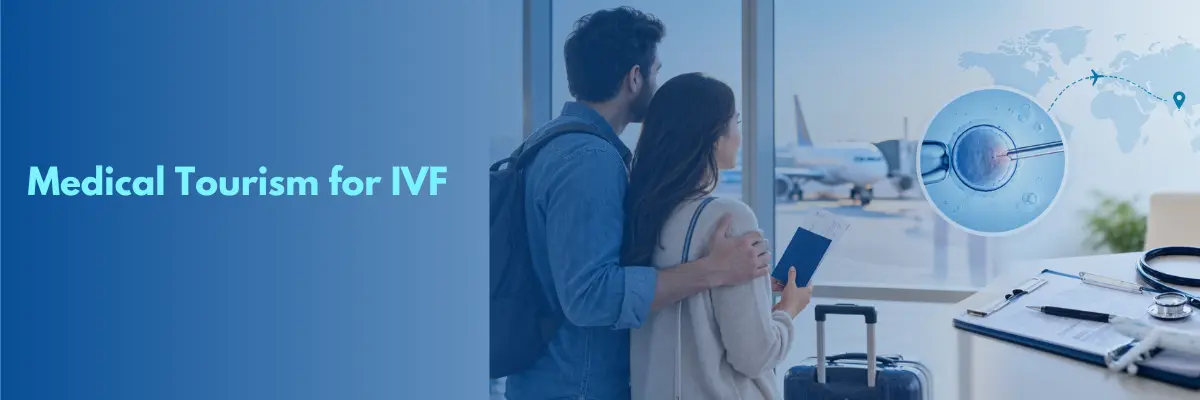
Settling on IVF abroad is more about prices for flights or a fertility clinic. Opting for IVF treatment abroad unveils new pathways for to-be parents to a wider range of fertility care options and a higher success rate of going home with successful results.
However, in order to achieve all of that, patients need to secure their travel, which adds several trips, visas, along with regular follow-ups across borders. This guide assists IVF for international patients with critical steps to be taken along the way, including factors of medical tourism such as travel logistics, financial planning due to currency differences, and legal regulations to adhere to for a successful journey patients are about to experience ahead of their travel.
How is medical tourism beneficial for IVF Treatment Abroad?
Where most think medical tourism is just a travel trend for treatment, some look at it as a hope of having results they couldn’t achieve where they reside. According to estimates made by WHO, 1 in 6 adults go through infertility across the globe. For such scenrios like the, fertility tourism becomes a mode of travelling to another location (mostly cross-border) for treatments like embryo transfer, fertility preservation, IVF, ICSI, donor treatment, and other similar services.
Some of the reasons for patients to travel for IVF in other countries are the following:
-
Visible cost differences in treatment compared to the patient’s home country.
-
Availability of specific reproductive or fertility treatments.
-
Less waiting duration
-
Easy access to the best fertility experts and specialized labs.
-
Varied legal frameworks
-
Available donor programs in permitted countries.
-
Ease of cultural and privacy considerations
Presently, patients are no longer concerned about gaining treatment in the cheapest countries, but about which country’s process syncs with their requirements, also in terms of being financially realistic, legally sound, and manageable under suitable circumstances.
Create Your Travel Timeline for IVF Treatment Abroad
The NHS says a complete IVF cycle occupies 3 to 6 weeks, with regular stimulation injections, embryo transfer, and egg collection included. That’s why it is crucial for patients to consider the treatment sequences with their chosen facility before travelling for the treatment.
For optimum execution of the treatment, patients must begin with a practical plan for IVF abroad:
-
Early Preparation (Before Travel Week 1 - 4 prior)
-
Brief review and consultation
-
Request for a treatment sequence in writing, as patients often are required to get prior surgery or tests done before going forward.
-
Some of the common tests are FSH, AMH, infectious disease, and pelvic ultrasound.
-
Submission of IVF cycle along with an overall medical history
-
Clinical Protocol upon Arrival (Week 1 - 2 after arrival)
-
A complete list of tests that are obligatory upon arrival.
-
Overall health check requirement to be fulfilled by medical tourists.
-
Submissions of follicular ultrasounds and ovarian stimulation from the last few days.
-
Administration of egg and semen preparation or collection, trigger shots, and the egg retrieval process.
-
If required: Genetic testing, embryo culture, fertilization through ICSI.
-
Transfer and Early Recovery Process (Days Taken: 15 - 20)
-
Embryo transfer, frozen or fresh, depending on the process taken.
-
Obligatory rest period for 24-48 hours minimum before travel clearance.
-
Back home, followed by progesterone support after completing the treatment.
Your Medical, Travel & Legal Checklist for Fertility Treatment Abroad
Travelling with fertility medications overseas requires elaborated preparation to take corrective measures for extending drugs’ efficacy along with complying with customs regulations.
The following are some of the mandatory things to carry while travelling to ensure that required medications come with you without any hassle:
Medical records
-
Identification page of the passport
-
Recent fertility and hormone records
-
Semen analysis (if required)
-
Previous ICSI, IVF, or IUI treatment documents
-
Genetic testing reports
-
Written schedule for medications
-
Ongoing medications and allergy list
-
Prescription list authorized by the doctor
-
Expert’s overall diagnosis
Travel & Legal Documents
-
Valid passport with a validity of more than 6 months
-
Travel authorization with a valid visa
-
Treatment Letter from the facility where the treatment is based
-
Confirmed accommodation proof
-
Flight information
-
Gamete or embryo transportation document (if required)
-
Travel Insurance
-
Donor reports
-
Insurance to check international coverage, and consider supplementary cover (if applicable).
Note: The requirements listed below are generic, as some of them vary country to country and might not be applicable everywhere.
Considering Ivf & Infertility abroad?
Share a few details and a Yapita Health medical advisor will get back to you with personalised guidance and a free, no-obligation cost estimate.
- Response within 24 hours · 100% confidential
- Vetted hospitals & board-certified doctors
- End-to-end travel & treatment support
Legal & Regulatory Frameworks to Follow
Rules and codes of conduct differ from country to country depending on fertility tourism destinations. Patients commuting for IVF in other countries are required to comply with their laws and must comprehend the requirements behind such adherence.
Varying by IVF treatment, patients need to consider rules that concern:
-
Informed consent
-
Eligibility level for IVF treatment abroad
-
Embryo or Gamete transportation
-
Genetic testing
-
Donor sperm or eggs
-
Citizenship or parentage
-
Surrogacy
-
Required papers to travel back
The During and After Care to Consider for IVF Treatment Abroad
|
Requirements |
What to Consider |
|---|---|
|
Companion |
To travel with a companion such as a Partner for sample collection and treatment support |
|
Transport |
Advised to accommodate near the treatment facility during frequent visits and follow-ups |
|
Lodging |
Not advised to travel until doctor’s clearance has been obtained by the patient |
The Aftercare of Treating IVF Abroad
-
Patient is required to collect all the necessary documents, medications, transfer date, embryo details, and share them with their local doctor.
-
Continue with advised medications according to the given sequence
-
Schedule a pregnancy test two weeks after transfer, as established by the NHS, to avoid any complications.
-
Further, have a transvaginal ultrasound once the pregnancy is confirmed at around 6 to 8 weeks.
-
Keep an eye out for ovarian hyperstimulation syndrome symptoms such as intense bloating, sudden breathlessness, and rapid weight fluctuation.
Also Read: IVF for Hopeful Parents: Guide for Foreign Patients
Why Prefer Yapita Health for IVF Treatment Abroad?
Planning to travel abroad for IVF treatment is overwhelming at so many levels. Yapita Health simplifies international patients’ treatment experience by assisting and guiding them throughout the treatment process.
With connected medical facilitators and hospitals across the globe (India, UAE, Turkey, etc.), Yapita Health supports patients from fertility evaluation to coordinating with them as the treatment progresses.
This incredible medical tourism company helps with:
-
Finalizing the best clinics or hospitals based on lab standards, accreditation, and visible success rates.
-
Reviewing visa documentation and guiding patients with travel formalities.
-
Presenting patients with cost estimations with transparent calculations.
-
Delivering records to your doctors for continuity purposes.
To know more, contact us at +919599818171 or reach out to us via email at support@yapitahealth.com to begin your treatment journey.
To Conclude
Starting an IVF treatment abroad requires practical planning, with patients needing to consider all the upcoming factors, including medical records, legal requirements, accommodation, treatment and medication sequence, cost requirements, and post-return care.
To ensure a smooth journey, associating with Yapita Health can assist patients without hustling about a single step throughout the way, as the facility guarantees to guide patients with complete transparency by advising the best treatment choice.