
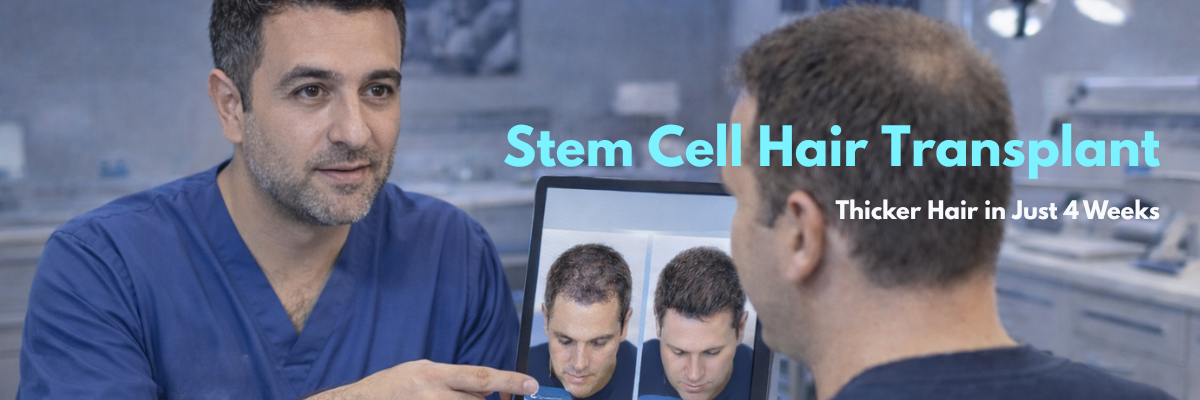
Stem cell hair transplant is one of the most talked‑about emerging options for people who want to treat hair loss without traditional strip surgery. It sits at the intersection of regenerative medicine, dermatology, and cosmetic hair procedures.
This technique was developed as therapy for burn patients by Dr. Coen Gho, an expert in hair restoration for burns and scars. It was first used for the victims of Volendam, Netherlands New Year's fire in 2001. It is a highly safe procedure that gives great results with naturally fuller, thicker hair growth.
The following sections will explore all about the technique, its benefit, lastly comparing it with traditional transplant method.
What Is a Stem Cell Hair Transplant?
A stem cell hair transplant is a procedure that aims to use the body’s own regenerative cells to stimulate new hair growth and improve the health of existing follicles.
Unlike a classic FUE or FUT transplant where entire follicles are moved from one area to another, many “stem cell” protocols focus on harvesting stem-cell-rich tissue (for example from fat or the scalp), processing it, and re‑injecting it into thinning areas.
Because there is no single global standard yet, clinics may use the term in different ways: some combine limited follicle extraction with stem cell-rich injections, while others focus mainly on regenerative injections without large graft transfers.
There are two main variations of this technique:
- Hair Stem-cell Transplantation (HST) which uses tiny follicle grafts with stem cells that produce natural results with high density.
- Adipose-derived stem cells use fat tissue for extraction, common in methods such as Regenera Activa.
Both methods provide exceptional results and only differ in their cost. The cost for stem cell hair transplant varies from country to country, with Turkey providing the treatment from $700 to $12,000 (grafts, clinic and treatment type affects the cost.) Similarly, the cost of exosome stem cell therapy combined with hair transplant can cost around $2,500.
Not everyone is suitable for this method (medication-related alopecia, alopecia areata, those without enough donor hair) so, it is important to follow your surgeon's recommendation after the consultation.
Let's have a look at how this method works.
How Does Stem Cell Hair Restoration Work?
Most protocols follow three broad steps:
-
Harvesting stem‑cell–rich tissue: The doctor collects tissue that naturally contains mesenchymal or progenitor cells, commonly from adipose (fat) tissue via a small liposuction, bone marrow, or specific scalp biopsies.
-
Processing and concentration: The harvested material is processed to separate and concentrate the cellular or exosome‑rich fraction. This can involve mechanical, enzymatic, or device‑based methods, depending on the regulations in your region.
-
Targeted scalp injections: The prepared solution is then injected into areas of hair thinning or miniaturisation. The goal is to create a healthier environment around existing follicles, improve blood supply, and encourage follicles in the “resting” phase to re-enter active growth.
Because it leans on the body’s repair mechanisms rather than simply relocating follicles, stem cell hair transplant techniques are often marketed as more “natural” and minimally invasive, though the supporting evidence is still evolving and highly protocol‑dependent.
Is Stem Cell Hair Transplant Permanent?
Patients often ask: “Is stem cell hair transplant permanent?” The honest answer is that results can be long‑lasting for some people but cannot be promised as permanent in the same way as relocating robust donor follicles.
Traditional transplants move genetically resistant follicles from the donor area; those hairs usually last many years. Stem‑cell‑based treatments mainly work by improving the condition and cycling of existing follicles, which may still be influenced by hormones, genetics, age, and lifestyle over time.
In practice, many clinics position this option as:
-
A booster for early‑stage androgenetic alopecia,
-
A supportive therapy around or after standard transplantation, or
-
An alternative for patients who are not good candidates for large graft sessions.
Patients should know they may require maintenance sessions or combined therapy with medications (like minoxidil or finasteride, where appropriate) to sustain gains.
Also Read: PRP vs Stem Cell
Stem Cell Exosome Therapy for Hair Restoration
A closely related technique is stem cell exosome therapy for hair restoration. Instead of using whole cells, exosome‑based protocols focus on tiny extracellular vesicles released by stem cells. These vesicles carry growth factors, signalling proteins, and microRNAs that can influence surrounding cells.
In hair loss cases, exosome preparations are injected into the scalp in a manner similar to PRP or other biologic treatments. The idea is that exosomes may:
-
Reduce local inflammation around follicles
-
Support blood vessel formation (angiogenesis)
-
Encourage follicles to move from resting to growth phase
Because exosomes do not contain living cells, they are often marketed as easier to store and use, but regulations around them are strict in many countries. Exosome treatments are still being studied, may not be approved everywhere, and that evidence is promising but not definitive.
Considering Cosmetic & Plastic Surgery abroad?
Share a few details and a Yapita Health medical advisor will get back to you with personalised guidance and a free, no-obligation cost estimate.
- Response within 24 hours · 100% confidential
- Vetted hospitals & board-certified doctors
- End-to-end travel & treatment support
Who Might Benefit from Stem Cell-Based Hair Therapies?
Stem‑cell‑oriented hair procedures tend to be discussed for:
-
Men and women with early to moderate pattern hair loss
-
Patients with diffuse thinning where classic transplant design is challenging
-
Individuals wanting a minimally invasive option with limited downtime
-
Patients planning a future transplant who wish to improve scalp condition beforehand
They are generally less suitable as a sole solution for people with very advanced baldness and poor donor reserves, where moving follicles remains the main way to rebuild coverage.
Expected Results, Downtime, and Safety
Most patients can return to normal daily activities quickly because there are no large incisions or extensive shaving. Mild soreness or swelling at the harvest and injection sites is common for a few days. Visible changes in hair density take time, often 3-6 months for early improvements and up to a year for full effect.
As with any medical procedure, there are potential risks: bruising, infection, uneven results, or lack of response. Outcomes depend heavily on:
-
The exact protocol and devices used
-
The quality and viability of the harvested tissue or exosome product
-
The underlying cause of hair loss
-
The expertise of the treating doctor
Patients should be counselled that these therapies are not magic cures and that realistic expectations are essential.
Stem Cell vs Traditional Hair Transplant: How to Position It
Here’s a comparison between the two methods of hair loss treatments:
-
Goal: Stem cell approaches improve existing follicles and scalp environment. Classic transplant physically moves hair from donor to bald areas.
-
Invasiveness: Stem cell injections are minimally invasive, smaller entry points. FUE/FUT are more surgical, with graft extraction and implantation.
-
Suitability: Stem cell is better for early‑stage thinning, adjunctive care. FUE/FUT is essential for rebuilding hairlines and large bald zones.
-
Evidence: Transplant is supported by decades of patient results and satisfaction. Stem‑cell‑based methods: Evidence around its effectiveness is growing but still positive; varies by protocol.
Whicever method you choose, it is important to pick an experienced surgeon/clinic for your procedure as it requires expertise and precision. Turkey has the best hair transplant surgeons in the world like Dr. Serkan Aygin who have extensive experience in delicate methods like stem cell hair transplant.
End Note
This was all about stem cell hair restoration and all the important aspects of this method. A generally safe procedure with minimal side effects, this method is becoming a popular choice amongst people seeking hair restoration. Choosing the right clinic and surgeon is an important part of your hair restoration journey and Yapita Health is here to help ease the process.
With our vast network of accredited and experienced hair transplant surgeons and clinics in popular destinations like Turkey, your journey becomes seamless and positive.
Contact us today to get a consultation with the best hair transplant surgeons in Turkey!